
Tour African-American Historic Sites in San Francisco
Go beyond the Gold Rush with this fascinating tour.

It’s San Francisco through a lens you’ve probably never seen—the city where poet Maya Angelou became a trusted advisor to Martin Luther King, Jr.; where California’s first African-American millionaire, Capt. William Leidesdorff, made his mark in the 1830s and ’40s; and where famed Western painter Maynard Dixon and Frank Van Sloun created a mural depicting 16th-century Black folklore heroine Queen Calafia.
These are a few of the highlights that celebrate people and places important to understanding Black accomplishments and contributions in San Francisco. If you’re interested in a detailed look at the Black experience, check out one of the year-round Black history tours offered by San Francisco City Guides. To explore on your own, pick up maps and brochures from the California Welcome Center at Pier 39 or visit these historic spots.
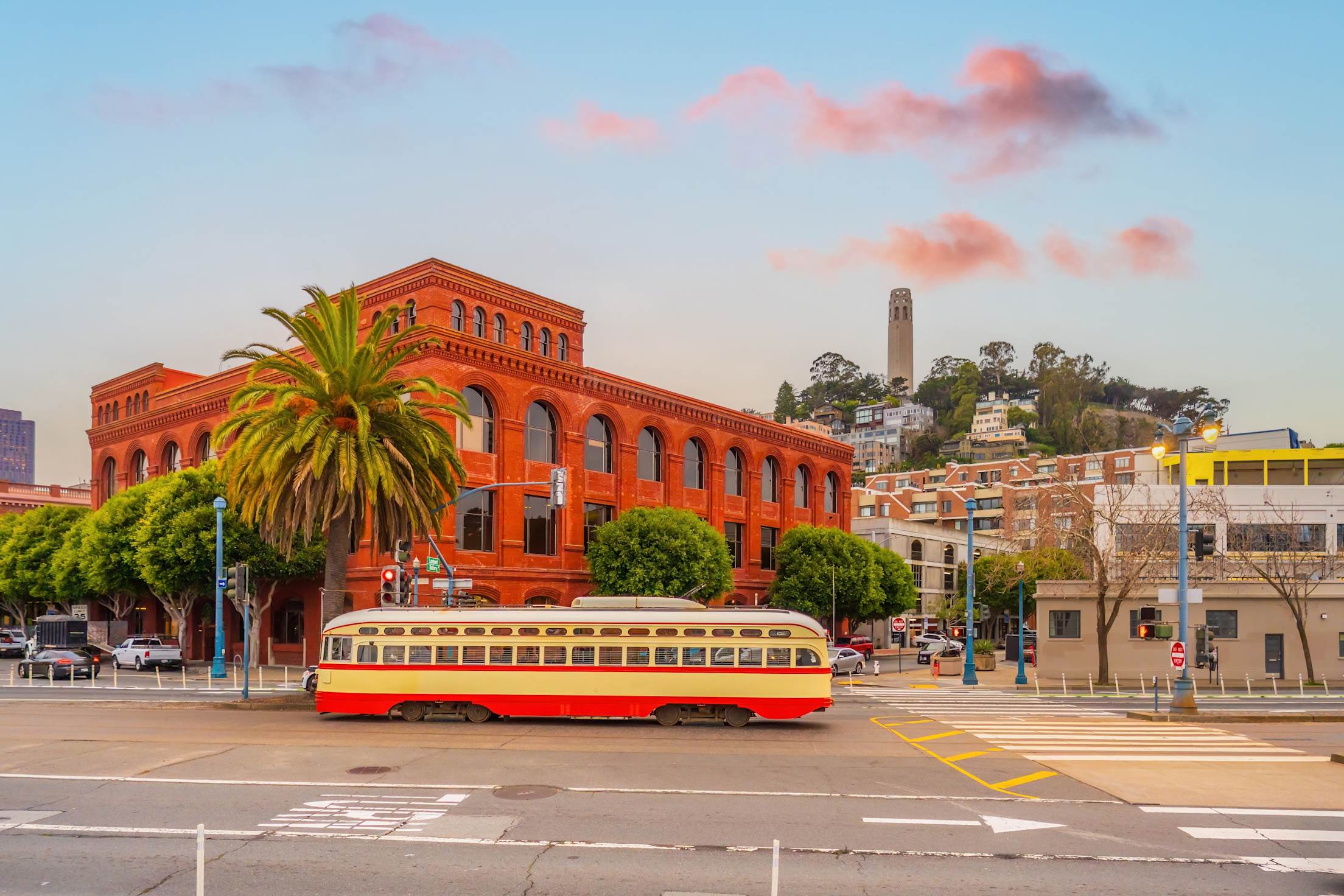
Hop on a historic streetcar car near The Ferry Building and marvel at how 15-year-old Maya Angelou sat in the railway office for two weeks until they let her apply, making her one of the first Black woman conductorettes in San Francisco before she became a celebrated poet and author. At Laguna and Post Streets, see her childhood home, now occupied by the Kabuki Hotel. Learn what San Francisco saga she recounted in I Know Why the Caged Bird Sings, and visit the site of the long-gone record store (at 1256 Fillmore St.) where a teenaged Angelou worked.
The store isn’t far from the former site of the 30-room mansion owned by the so-called “mother of civil rights in California,” Mary Ellen Pleasant, a 19th-century African-American multimillionaire and West Coast sponsor of the Underground Railroad. Today, Mary Ellen Pleasant Memorial Park, basically five massive eucalyptus trees and a plaque, sit in place of her former home at the corner of Octavia and Bush Streets. Unpack Pleasant’s life and legacy on the SF City Guides’ Japantown tour, which also explores how after Japanese residents were sent to concentration camps during World War II, Black families moved in and created the Fillmore Jazz District.
A street named in Pleasant’s honor still exists in Nob Hill near the InterContinental Mark Hopkins Hotel, which houses the historic Maynard Dixon paintings of Queen Calafia in the Room of the Dons. While in the neighborhood, learn Hopkins’ connection to three other businessmen, who together were nicknamed the “big four,” and discover how they may have helped further the abolitionist movement in the West.
Downhill from the Mark Hopkins, at the southwest corner of Market and New Montgomery Streets, is the Palace Hotel. It was there, in 1964, that African-American teenager Tracy Sims led 2,000 demonstrators in a sit-in against employment discrimination and won an equal opportunity agreement with 37 major hotels.
Looking northeast from the Palace towards the San Francisco Bay, you may be surprised to learn that much of the land you see was underwater during the Gold Rush. The coastline stopped at what is now Montgomery Street. Today, a bronze statue at Leidesdorff and Commercial Streets depicts Leidesdorff, thought to be the state’s first black millionaire. Learn his remarkable story of disappointment and triumph—from West Indian immigrant to successful businessman.
Take a deeper look at the life and accomplishments of this Afro-Caribbean entrepreneur, diplomat and public servant on the SF City Guides’ 1840s San Francisco and the Astonishing Legacy of America’s First Black Millionaire tour. He amassed an impressive estate called Rancho Rio de los Americanos. But after his death, sharp-elbowed real estate investor Joseph Libbey Folsom sailed to the Virgin Islands and convinced Leidesdorff’s mother to sell the land for a fraction of its value.
Faith has often offered respite from injustices, and the same is true in San Francisco. Just across Alamo Square from the famous Victorian Painted Ladies, is Third Baptist Church—a well-known institution among African-Americans. Paul Robeson, W.E.B. DuBois, and Martin Luther King, Jr. all visited the church at 1399 McAllister St. in their time. It wasn’t always a church, though. You’ll learn what it used to be, and which American president visited before it was disassembled by hand.
You’re bound to feel hungry along the way. Fortunately, you can find a list of excellent Black-owned restaurants on SF Travel’s Black Experiences guide. A new Fillmore Street favorite is Minnie Bell’s Soul Movement, which was named a 2025 Best New Restaurant by Bon Appétit magazine. Chicken is the star at Minnie Bell’s, and it’s juicy, whether you order the hot honey wings, rosemary chicken or Southern fried with all the sides like brown-butter cornbread, candied yams, and braised greens. Or opt for a classic stop in the Lower Haight/Fillmore: The Peacock Lounge & Gold Room, a music and private event venue dating back to 1960. The last Black owned business on the the block, local celebrities and musicians in the know turn up to see emerging jazz and rock artists and comedians. Manager Jerome Walker says the non-profit bar and food venue uses proceeds to fund scholarships and special events for the nearby elementary school.
Let AAA Travel Advisors plan your trip to San Francisco. It is an exclusive benefit for AAA Members.